For a fine artist, JoAnn Peralta has always had a technical mind. “My kindergarten teacher told my mom I would become an artist because of the attention to detail I had in my art projects, and my mom didn’t believe her,” she says. “My parents thought I would go on to do something in math or science.”
Peralta credits her math-mindedness for helping her understand shape and space in her paintings. “My geometry skills have informed the three-dimensional way I think,” she says. She even wrote a book called Mathface about the way she connects mathematics and art. “You can pivot and turn something in a 360-degree space and change the angle to show a different view in the same plane. That’s something I’ve always been able to do in my head.”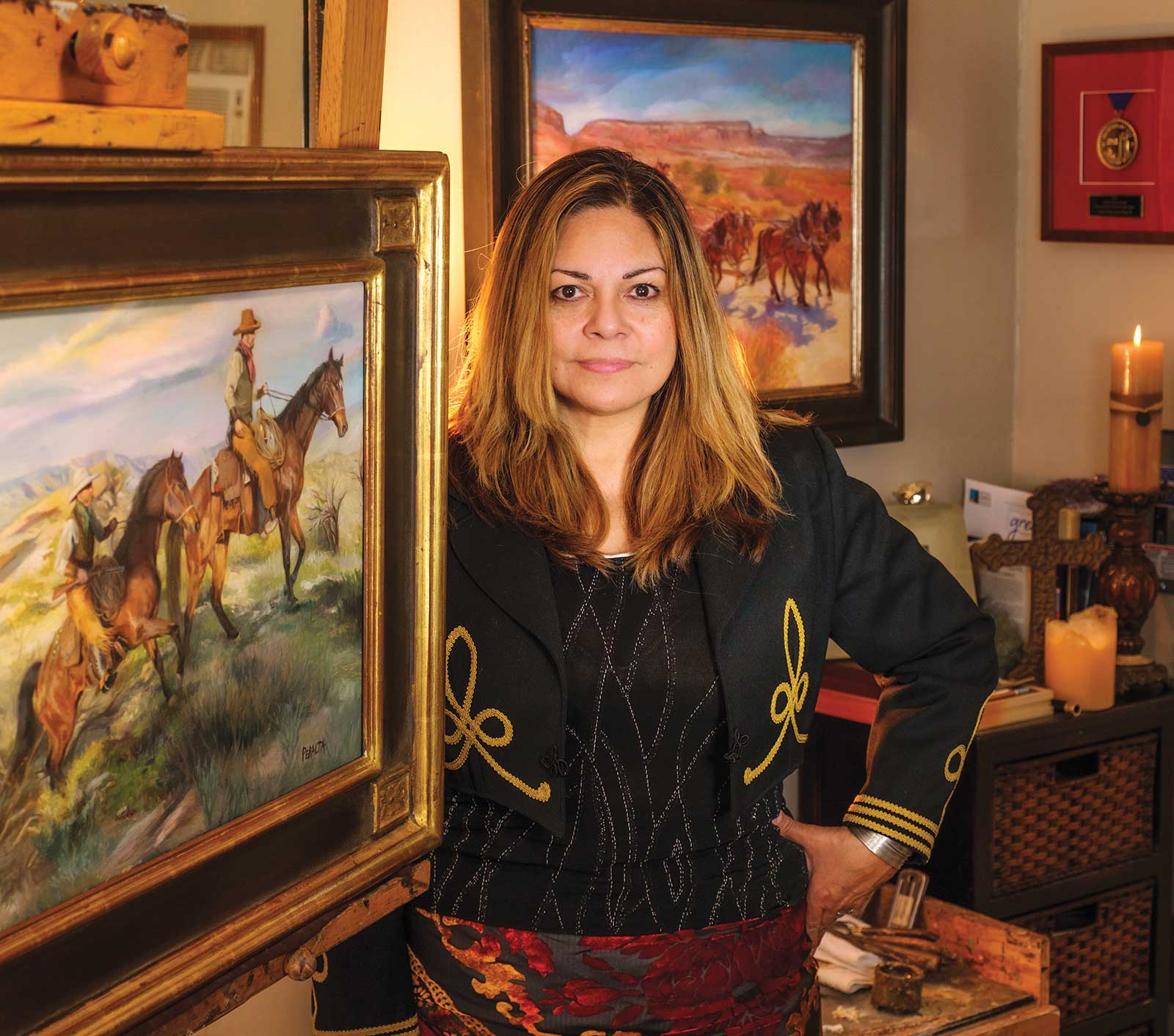 JoAnn Peralta in her studio
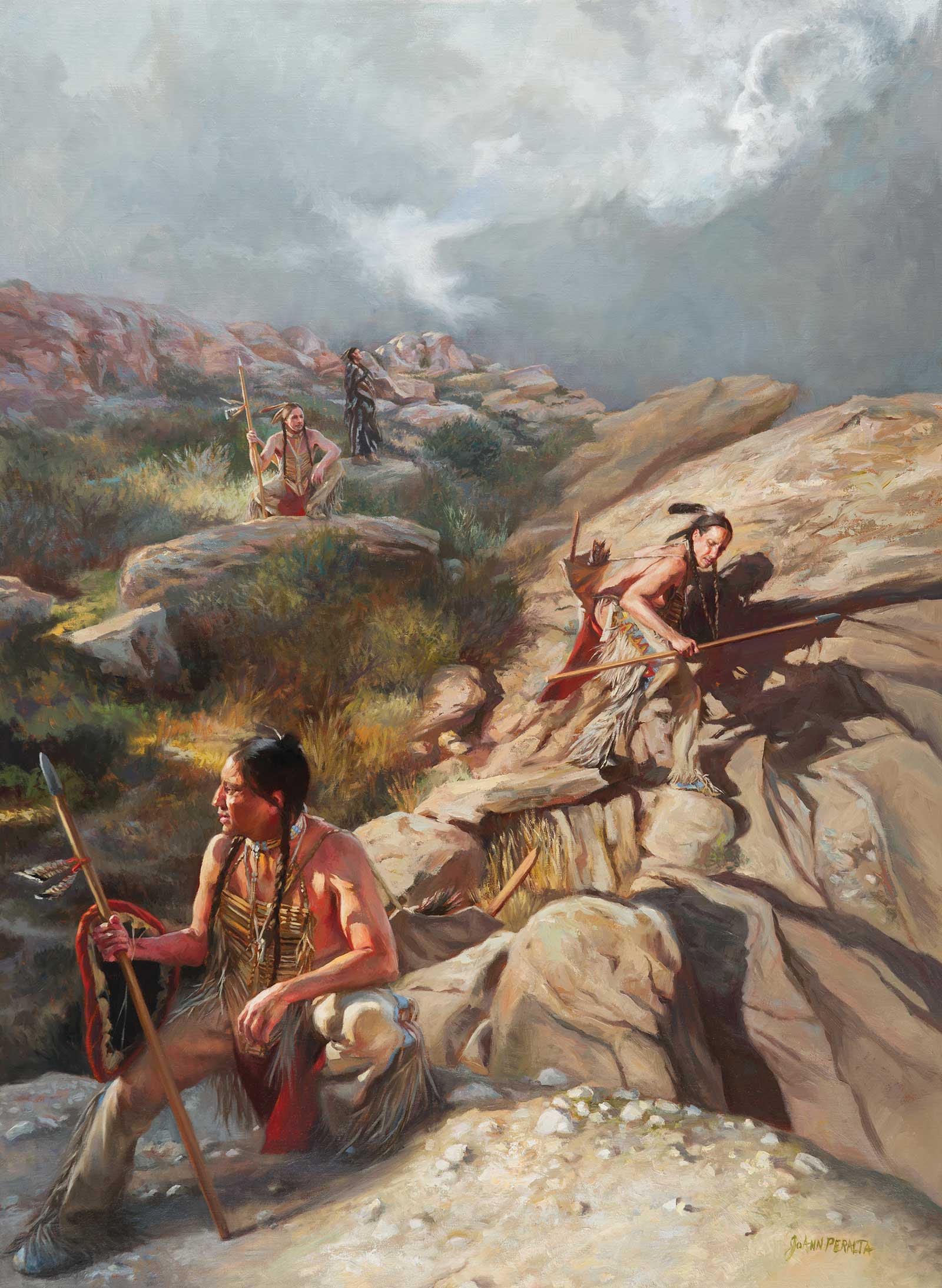 Great Spirit in the Sky, oil, 53 x 30”
While Peralta didn’t go into the sciences, her path to becoming a Western artist wasn’t a straight line, either. She worked in many careers—from computer escrow agent to travel agent—but always had art on the brain.“I was always drawing, always painting, always exploring watercolors,” she says. While working as a travel agent, two different art students came in on the same day and saw the drawings Peralta was working on during her break and encouraged her to go to art school.
“Since it happened on the same day, I said, ‘All right, I’ll do it,’” she remembers. On her next day off, she went to the school and met with an advisor who told her there would be a portfolio review in two weeks’ time.
“I had nothing,” Peralta says. “I went home and did 12 pieces of art in two weeks and brought them in for the review.” Three days later, she got a call that she had been accepted—and given a scholarship.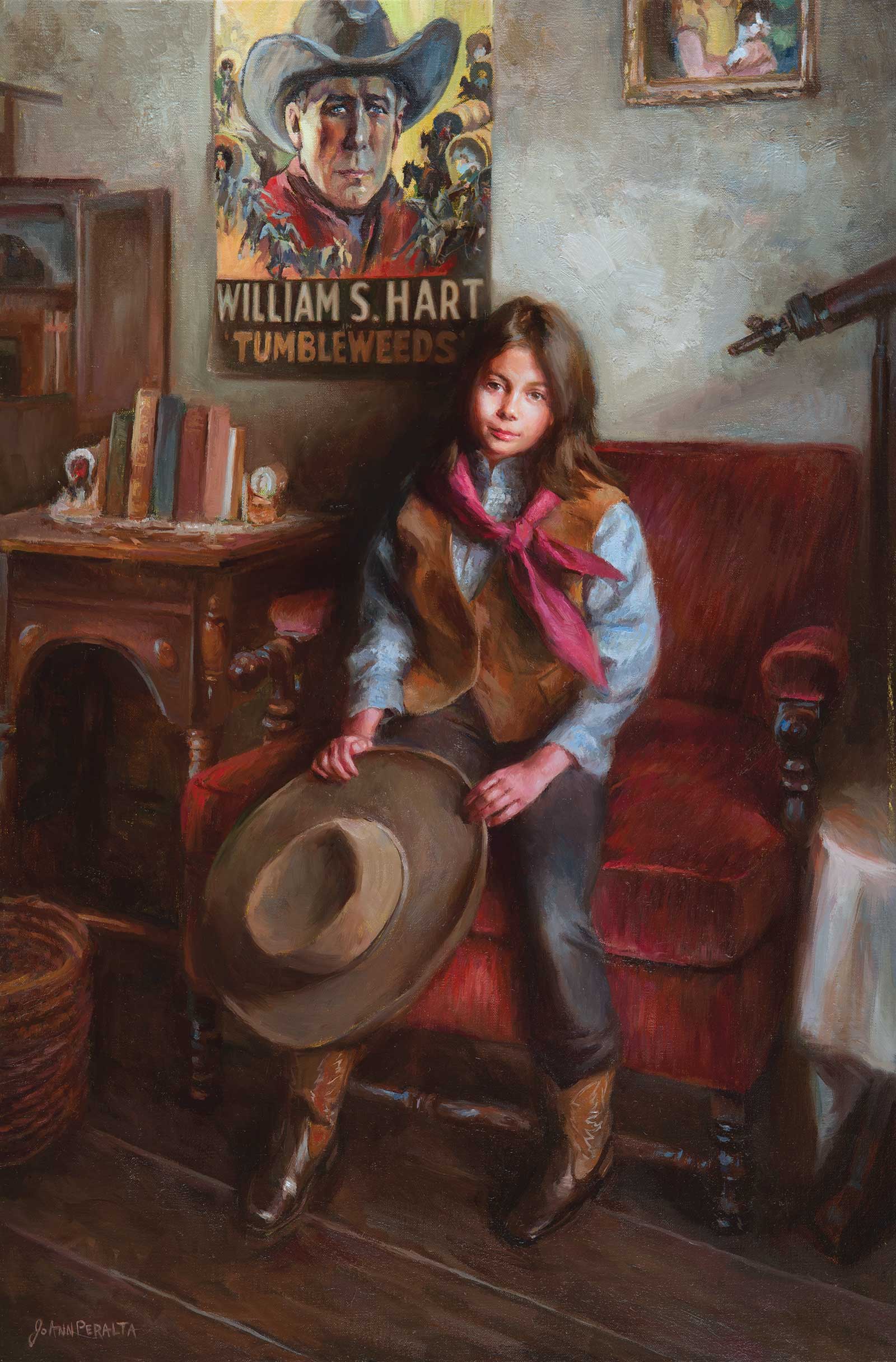 Heart of the West, oil, 30 x 20”
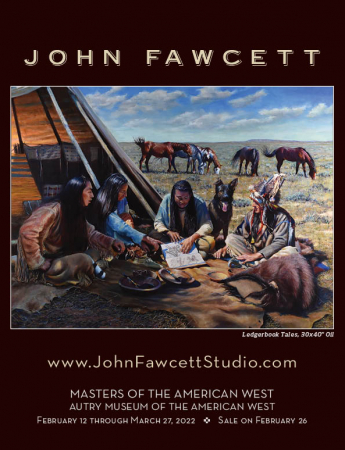
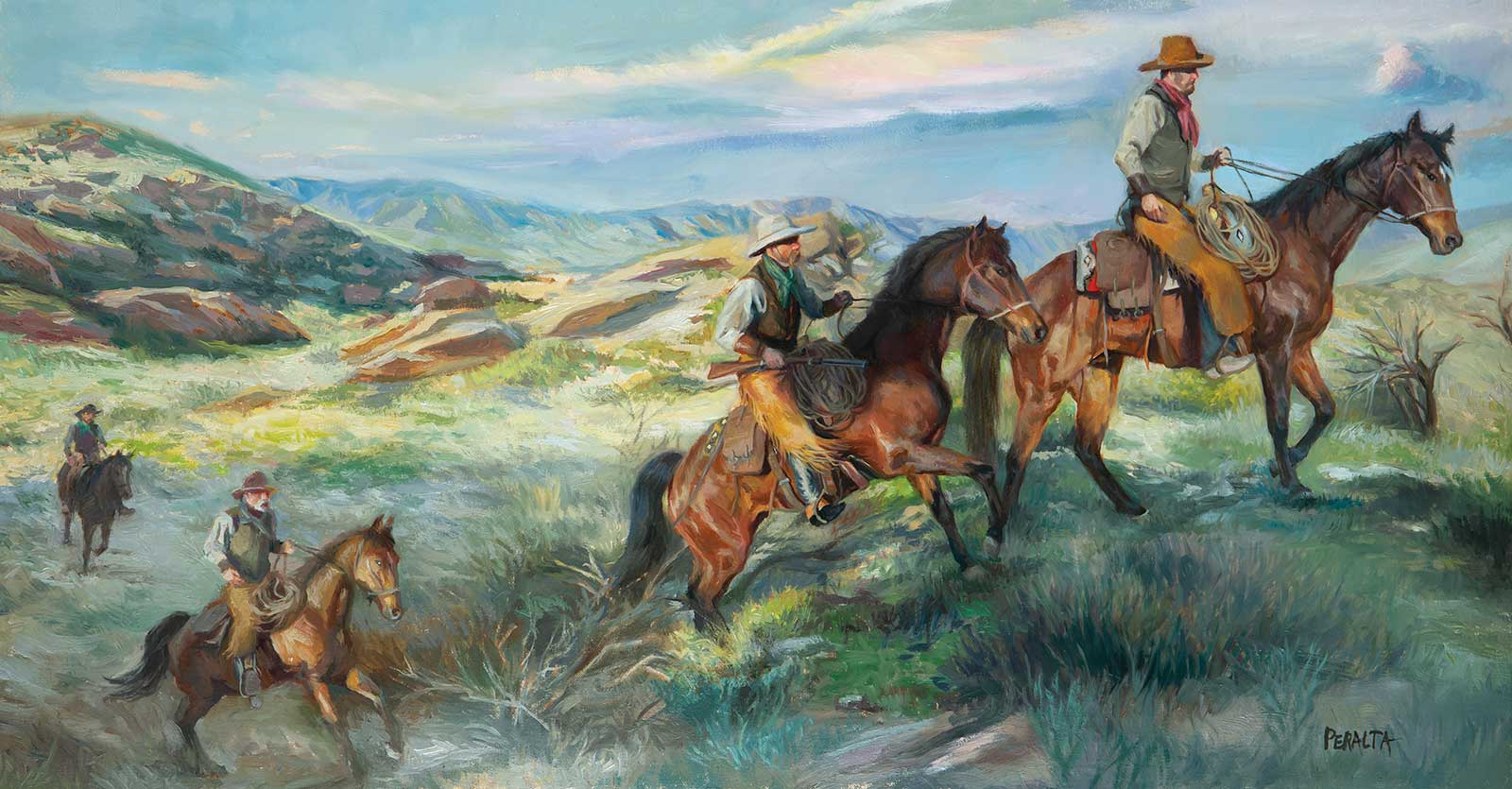 Trailblazers, oil, 16 x 30”. Available at the 2022 Masters of the American West at the Autry Museum of the American West, Los Angeles, CA.
As she studied, she focused on the works of Renaissance masters and impressionist artists. “I didn’t know yet what my passion would be, all I knew was that I knew good art when I saw it.” She was drawn to van Gogh because of his colors, Caravaggio because of the dramatic use of lighting and Michelangelo because of the authentic, scientific way he presented the human form. Her admiration for these artists fused with her childhood love of TV Westerns, started her down her road to becoming a Western artist.
“The High Chaparral was my favorite show growing up. It was in syndication when I was 11 or 12, and I was so drawn to the grittiness and the horses,” Peralta says. “I loved that it had Latino actors playing Latino characters, not Anglo Americans wearing face paint.” Eventually, she was able to get to know actors from The High Chaparral and even did a painting of star Henry Darrow that the actor hung in his home office.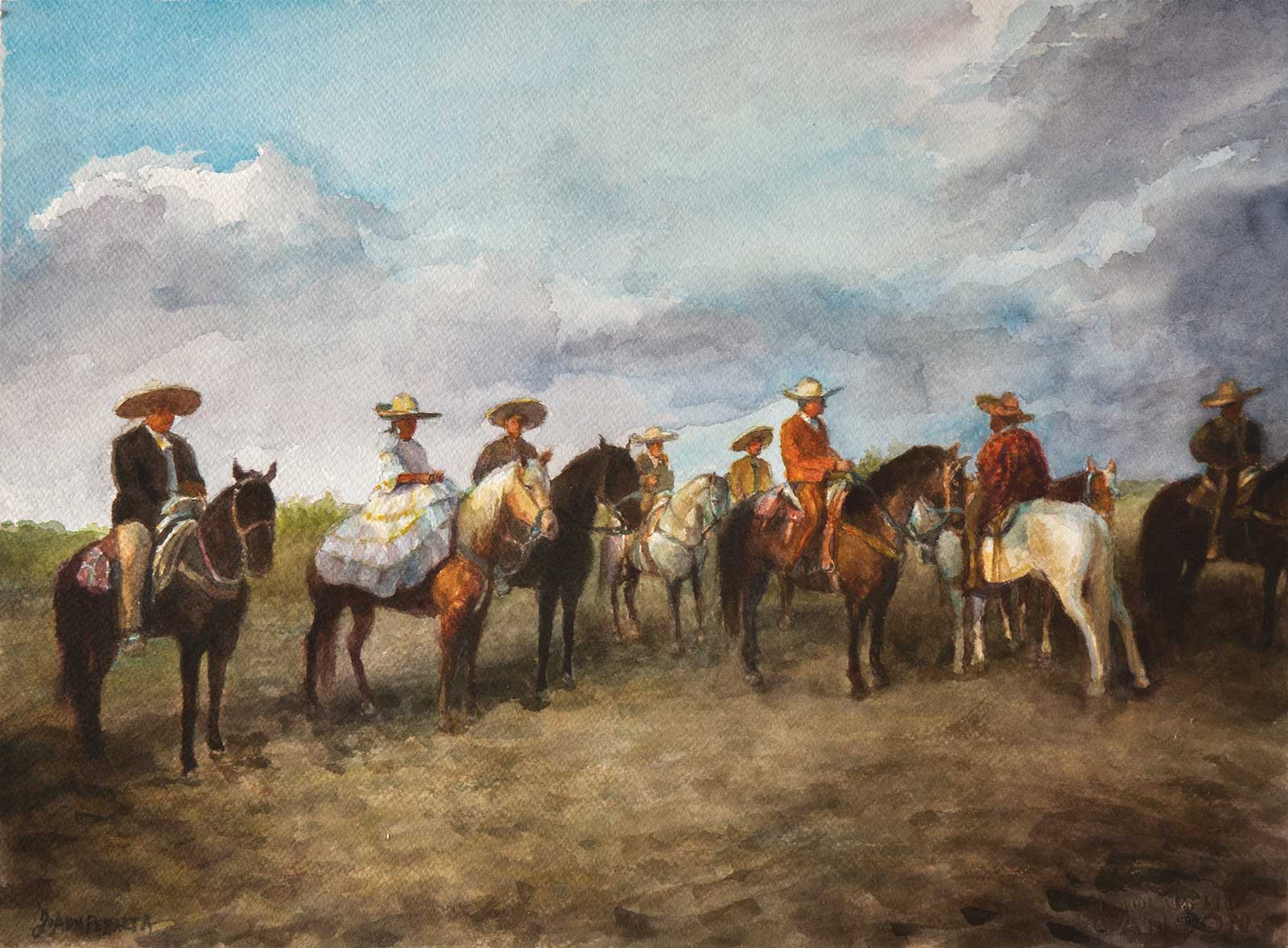 Riders on the Trail, watercolor, 12 x 16”
However, even though she had an abiding love of TV Westerns, Peralta didn’t immediately start painting Western art because she was intimidated by the musculature and movement involved in portraying horses. “Once I really got the human figure down, I was able to see how the human form connected to the musculature of animals and started to think, ‘If I could do the human figure, I could do this.’”
One year at the Masters of the American West at the Autry Museum, she asked painter Howard Terpning about how he achieved such success, and he told her that the secret was to never stop learning.
“There he was, this master artist, telling me he was still learning things, and that really encouraged me,” she says. “I really felt like it was the time to really hit the ground running with my passion for Western works and the beauty of this region and how it was formed by the pioneers and the Native Americans. I resolved to never stop learning, and I’m constantly trying to add to my understanding of the history.”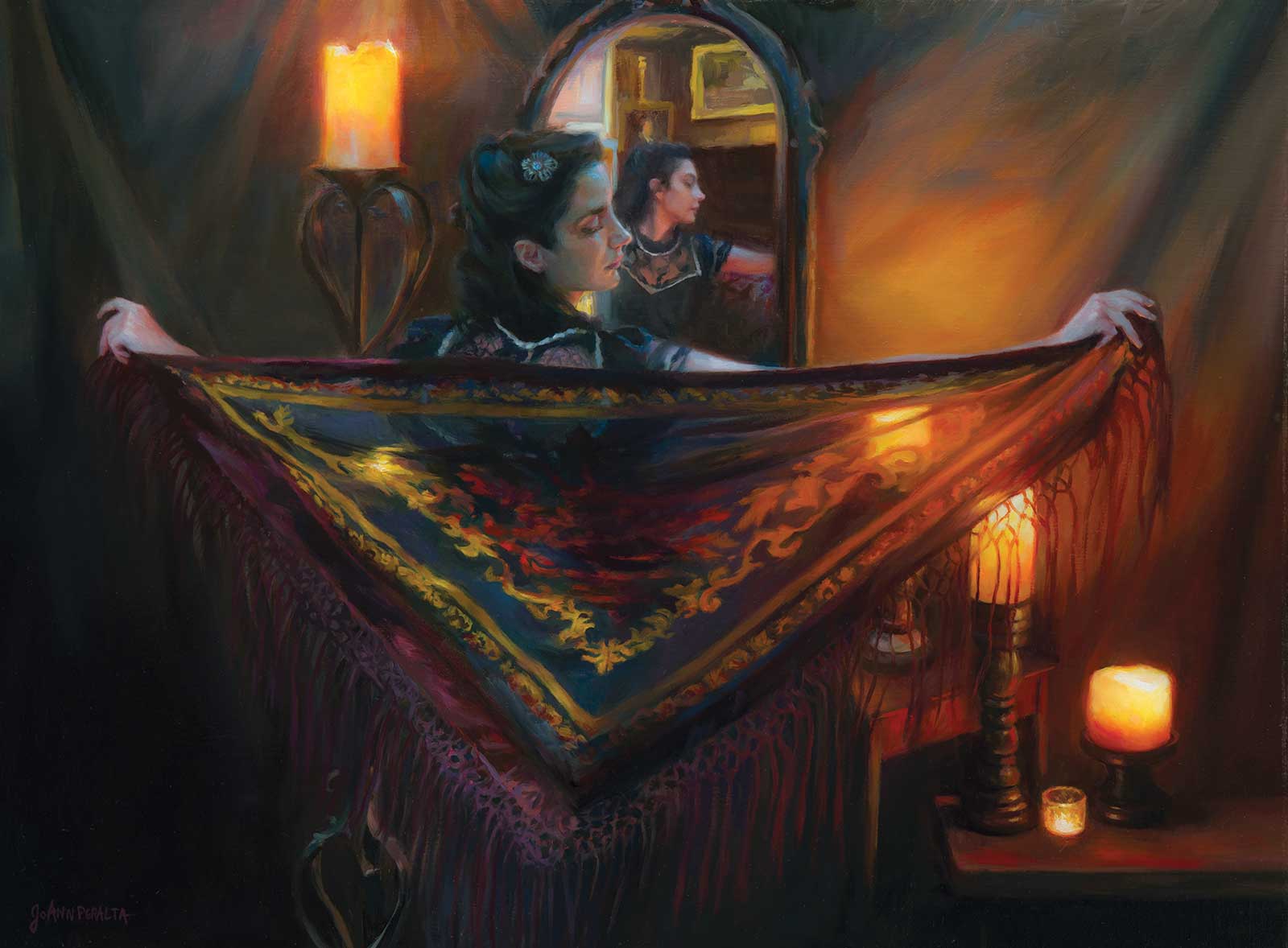 Spanish Shawl II, oil, 26 x 36”
Coming from an illustration background, many of Peralta’s paintings start from nothing but the ideas that spring up in her mind. “I like to think I was educated at the tail-end of the golden era of illustration. I learned how structure works well enough that I can compose a painting out of nothing,” she says. “For example, I’ll think, ‘I want to create a painting about the story of Pete Kitchen and his wife Rosa,’ and with my illustration background, I can form my thoughts to start composing a sketch.” She may use photo references or references from life later in the process, but starting out all she needs is charcoal and a sketchbook to get a feel for what the finished painting is going to look like.
“Because I know perspective, I can compose everything to look like it would if it were actually in front of me,” she says. “When you understand the human figure and the anatomy of animals, you can compose from all sorts of sources all at once and make them look like they belong together.”
For the upcoming Masters of the American West show at the Autry, Peralta will be showing Stagecoach of the Rio Grande, 1865, which shows a team of horses carrying passengers and their possessions through a desert landscape. “The painting is about my love of the Western territory and the way people had to travel to expand the West into what we know today,” she says. Peralta hopes that paintings like this one inspire people to learn more about the history of the West.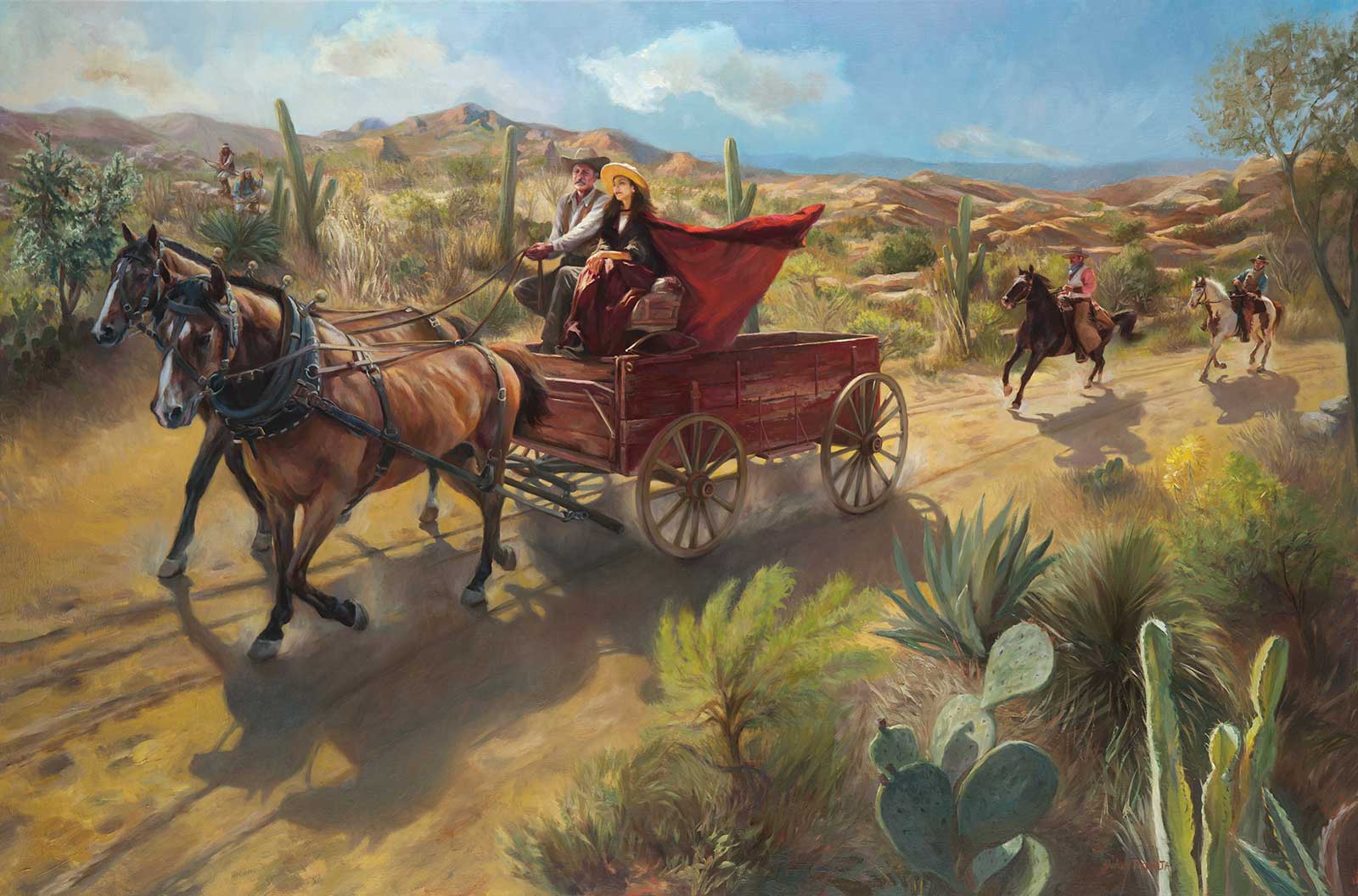 “Peace in the Valley” — Treaty Between the Kitchens’ Ranch and Cochise, Tucson, 1873, oil on linen, 40 x 60”
“Our history shouldn’t be forgotten, and I try and produce paintings that show my passion for the cultural differences on American soil,” she says. “This travel painting is trying to interpret the expansion of this territory by stagecoach and all the people who had to go through this uncharted terrain.”
Peralta is currently working on another large piece for the Masters titled, Trailblazers, featuring four men on horseback cutting through rugged terrain. “I think everyone can relate to the idea of being a trailblazer in some way,” she says. “I feel like a trailblazer as a woman in Western art. It’s a field that’s diverse in a lot of ways, but when I started out, I was one of the only women doing figurative Western work.”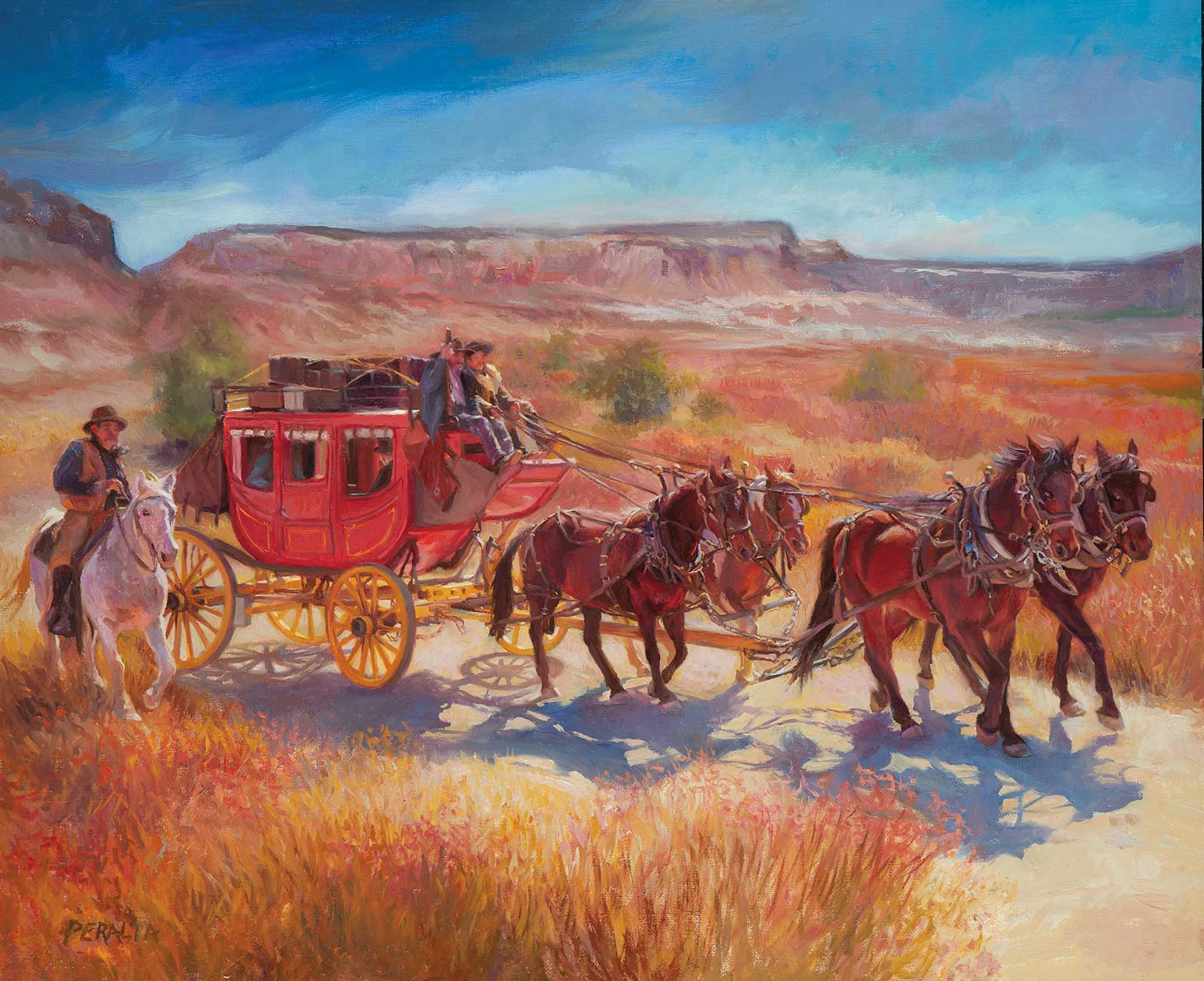 Stagecoach on the Rio Grande, 1865, oil, 20 x 24”. Available at the 2022 Masters of the American West at the Autry Museum of the American West, Los Angeles, CA. All images courtesy the artist.
Trailblazers also touches on her love of cowboy history and is reminiscent of a watercolor piece she painted a few years ago that portrayed vaquero riders. ”People just don’t know about the Spanish history of teaching horsing skills. Spaniards were the ones who brought horses over and taught many of their techniques to the Lakota, which is pretty major.” The horsemanship seen in the watercolor painting, as well as Trailblazers, exemplifies the enmeshment of cultural knowledge that helped to create the American West as we know it.
“There’s so much history that we can explore through art. I think we should have gratitude and learn about how we became who we are today,” Peralta says. “It’s such a beautiful time to live right now as an artist with so much diversity and diversity of perspective.” —
Powered by Froala Editor